

In the shadow of an escalating conflict that already seems to be reshaping the global balance of power, the US has become entangled in a war with Iran, resulting in a strategic stalemate with massive implications and consequences. President Trump is confronted with two options, each of which will definitively set the course for America in the years ahead. Specifically, he must choose between a generalized conflict with Iran or a silent retreat—a choice that no longer concerns only the Middle East but touches the very core of American hegemony. Against a backdrop of energy threats, geoeconomic realignments, and the challenge to the dollar, the lingering question is whether the US is facing just another crisis—or the beginning of the end of its global dominance. Within this framework, various positions find room to grow, such as the 22-point "nightmare" manifesto of Palantir. These ideas amplify the terror, especially considering that American generals fear President Trump is capable of even launching a nuclear war, although he has ruled out any scenario involving the use of nuclear weapons in Iran.
Michael Hudson (American Professor): Generals fear Trump
American generals fear that US President Donald Trump is capable of launching a nuclear war, stated University of Missouri professor Michael Hudson. "Right now in the US, there is an irrational model, as evidenced by press reports regarding the disputes taking place in the White House Situation Room, where generals simply refuse to hand over the nuclear codes to Trump because, in their words, he would have used them last Saturday. The situation is that irrational," warned the American professor, who underscored that the White House chief’s approach to decision-making is becoming increasingly absurd. It is recalled that former CIA analyst Ray McGovern had called on the American military to disobey a Trump order should he decide to carry out a ground operation in Iran.
The Israel trap
The word "trap" is repeated more and more frequently in America itself to describe the situation in which Donald Trump found himself regarding Iran, at the urging of Benjamin Netanyahu. However, it would be more accurate to say that this is due to the close connection between the formation of American interests and Israel, where political radicalization has occurred over the last 10–15 years. This trap, it seems, has proven fatal for modern America. Washington cannot act like Tel Aviv in Gaza and Lebanon: if it did, the difference between them would be permanently erased—Israel would not rise to the level of America, but America would shrink to the dimensions of Israel. These are the stakes that the American establishment and those personally involved in the Iranian front, including the military, cannot fail to perceive. As recognized in Israel itself, it is "losing America" on this wave.
Historic opportunity for the Guards
Facing the Islamic Revolutionary Guard Corps face-to-face (a result of betting on the elimination of the country's political leadership), Washington is forced to legitimize this power segment of the Iranian political system by entering into indirect negotiations with it. Indeed, it is a segment that the Americans have designated a terrorist organization, which obviously does not want to lose the historic opportunity presented to it to single-handedly end not only the US-centric order in the Middle East but also the entire global hegemony of the US, while it sits in a position of dominance in the escalation. Who would have imagined that fate would reserve for Tehran the role of the biblical David in this duel with the newly appeared Goliath!
The Iranian... nuclear bomb
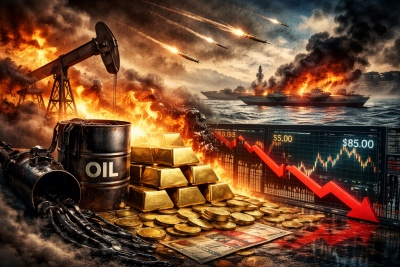
On a technical level, a situation is emerging analogous to the first half of the 1970s, when Washington abandoned the gold standard and used the 1974 oil crisis to introduce the petrodollar system, where oil prices on global markets were determined in dollars, creating artificial demand for the US currency. Throughout the 1970s, the US was in a state of severe economic crisis. By closing the Strait of Hormuz, something rightly called the Iranian nuclear bomb, Tehran found itself in a position to trigger a global recession with catastrophic consequences for the American economy and the deconstruction of the petrodollars themselves.
Goodbye... America
China has already begun buying oil from the Arab countries of the Persian Gulf in yuan, but now, after the destruction of their energy infrastructure—which could be total in the event of a second round of military confrontation—they lack precisely those dollars for reconstruction and simply for living under peacetime conditions. The UAE asked the Americans for a Fed swap line; otherwise, they will be forced to switch to the yuan, which would mean a strategic shift toward Beijing, essentially "Goodbye, America!". It's nothing personal! Everything proved to be built on sand—literally and metaphorically. Why, then, did they have to risk it all?
The dilemma
Washington faces a choice: to launch a second round of strikes against Iran, something it clearly desires and perceives that the outcome of the conflict must be definitive and therefore military, without any diplomacy; or, under one pretext or another, to accept the Iranians' terms and silently withdraw from the region, paying nothing and returning to the embrace of the MAGA electorate, as long as all is not yet lost for the Republicans ahead of the November midterms. It is clear that the determination and management of the Hormuz regime remains with the Iranians in either case.
The beginning of the end of hegemony
This is a choice that will either permanently destroy respect and trust toward America or return them to it, but on terms of its normalization as one of the leading global powers—a status it will have to prove day and night with successes in its own development, including technological, and by refusing to exist at the expense of the rest of the world. Otherwise, nothing will succeed, just as nothing has succeeded in recent decades when the American elites considered that the notorious "leadership" had been given to them from above for eternity and that it was not at all necessary to prove their right to it. Already 20 years ago, Zbigniew Brzezinski wrote that for America to maintain its status in world affairs, its foreign policy must be guided by more than narrowly defined national interests and that this vision for the future of the world must be shared by other countries.
Allies keep their distance
Only Americans can answer the challenge of the situation formed in the conflict with Iran. Everyone else, including the allies, has already adopted a detached stance, and this detachment, instead of military or other power, is a kind of Italian farniente, which has essentially already dissolved NATO, similar to the Iranian peaceful nuclear bomb. Let us remember that it was precisely the detachment of the countries of the Global South and the East from Western policy that condemned the pressure of sanctions against Russia in relation to the Ukrainian conflict to failure. What remains is what could be called a cultural war of extermination—which Russia experienced in 1941–1945 when the German Nazis acted in the name of "civilized Europe"—that is, outside the framework of international law, including humanitarian law.
The Palantir manifesto
This is summarized in the 22-point manifesto of the company Palantir, in which, among other things, it is proposed to forget the moral side of political decisions and to act ruthlessly against enemies representing other civilizations, based on the perception that among civilizations, there are successful ones and "malicious" ones. Among these enemies, Iran and Russia are named. This apotheosis of militarism with a leaning toward artificial intelligence ("Let it fight!"—the peak of the dehumanization of war, a path the Americans already entered with the "war on terror" relying on drones) and totalitarianism proclaims the goal of creating a new, high-tech corporate state—the "technological republic" of Alex Karp—under the leadership of BigTech, whose priests know better than everyone else. As if the world hasn't had enough experience with the corporate state in the form of European fascism/Nazism! And how did the colonial empires managed by private enterprises differ from this? The British East India Company itself led India to the Sepoy Mutiny in 1857, after which London took over the administration of the colony itself.
Use of nuclear weapons
The use of nuclear weapons is not far from here—fortunately, Trump denies it, stating that he has "already won anyway"—since, in the perception of Palantir founder Peter Thiel, the Antichrist already walks among us: religious eschatology will justify even this. In the "Apocalypse of Our Time," the Russian philosopher Vasily Rozanov wrote much that was bitter about Christianity and Russia's historical fate, but he recognized that in the catastrophe of the European war "everything collapses into the void of the soul, which was deprived of its ancient content," which was Christianity. Neither to him nor to anyone to this day in the Christian world—the Nazis turned to occultism—had it occurred to attempt to manage an arbitrarily declared apocalypse, that is, to assume the role of God—hence the conflict with the Vatican. Or perhaps the elites, in whom there was a deep consciousness of their exceptionalism in the form of self-election and self-justification, and consequently of their right to genocide, inherited from Protestant fanatics, indeed cannot offer anything else either to their people or to the rest of the world? The issue is also that, as military historian Michael Vlahos wrote in his essay "America is Religion" in The American Conservative, historically America was something more than a modern nation-state and, in its messianism, was close to Eastern civilizations, having the mission to fill this "void of the soul" of Rozanov.
Modernity subtracts; it does not offer. The judgment regarding the "primitivism" of the other creates the conditions for their dehumanization, as does Israel's position regarding a supposed "nuclear holocaust."
The US cannot achieve strategic victory
Consequently, by denying Iran the right to what America once was—but lost as a result of six decades of failed wars—Washington is in principle unable to formulate a strategic victory over Iran. The current "redemptive narrative" of the elites is summarized in the slogan "peace through strength," the implementation of which must reinforce the legitimacy of American power itself, which internally and externally has entered the path of "coercion and punishment." This interdependence, as Vlahos considers, constitutes a "mutually destructive dynamic."
Global pariah
The question is whether the Americans themselves are ready for the transformation of their society and state proposed by the IT billionaires. Time will tell. But if America enters this path, then it will oppose the rest of the world in the most decisive way and turn into a global pariah. No one will watch this transhumanist turn of the self-destructive policy of the American elites from a distance. Unfortunately, Trump's statement about the intention "to destroy Iranian civilization" is consistent with the above prescriptions. One would hope that behind this rhetoric there is nothing more than annoyance at the fact that Tehran is behaving "dishonestly and wrongly," destroying the initial and unfounded expectations of Washington and Tel Aviv.
America's path
To put it more simply, the choice for America remains the same as formulated by independent political analysts as early as the Barack Obama era: either to cling to existence within a closed system—that is, an increasingly illusory control of the world—or to learn to live in an open system, competing/contending with all other countries. And it seems that precisely Iran will help the American elites make the right choice—in accordance with the spirit of the times and the real capabilities of America itself, which for the first time in modern history were exposed so clearly in the Middle East and beyond.
www.bankingnews.gr


Σχόλια αναγνωστών